


Imagine asking an AI assistant, "Which customer orders are still pending?" and getting an answer directly from your company's own records.
Or imagine a hospital using an AI assistant to help staff find information across thousands of internal documents.
These examples show why businesses are exploring something beyond general-purpose chatbots: AI applications designed around their own information, workflows and customers.
ChatGPT Was Just the Beginning
Generative AI introduced many people to technology that can write, summarize, answer questions and create content. But business requirements are often more specific.
A retail company may need an assistant that understands inventory. A manufacturer may want help reviewing maintenance records. A customer service team may need answers based on its latest policies.
That's where custom AI applications become interesting. Instead of asking a general chatbot to understand everything, businesses can connect AI capabilities to the information and processes they actually use.
AI Adoption Is Growing, but There's a Catch
According to McKinsey's State of AI in 2026 report, 89% of survey respondents said their organisations regularly use AI in at least one business function. The share of organisations using AI that have reached the scaling phase increased from 38% in 2025 to 44% in 2026.
However, 56% were still experimenting with or piloting AI rather than scaling it across their operations.
The report also revealed an interesting development: 32% of respondents said their organisations had decided against purchasing at least one software product or feature because they could build it internally using AI coding tools.
This highlights an important shift. Businesses are no longer just exploring what AI can do; they are increasingly looking for ways to integrate it into everyday operations and develop solutions tailored to their specific needs.
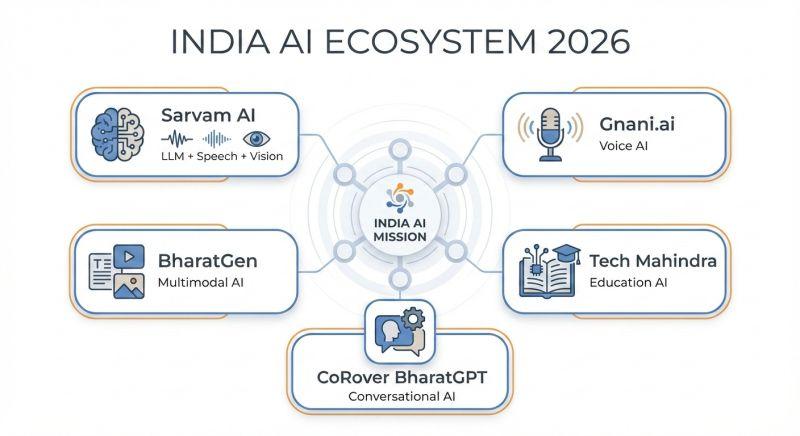
India Is Building More of Its Own AI Technology
India's AI story is also moving beyond simply using tools developed elsewhere.
In August 2026, the Government of India reported that the IndiaAI Mission had selected 20 indigenous foundation-model proposals, including large multimodal models and smaller language models.
These initiatives aim to support AI technology suited to Indian languages, local needs and different industries.
For developers and AI companies in India, this could expand the options available for building applications that serve Indian users.
Read the government's IndiaAI Mission update.
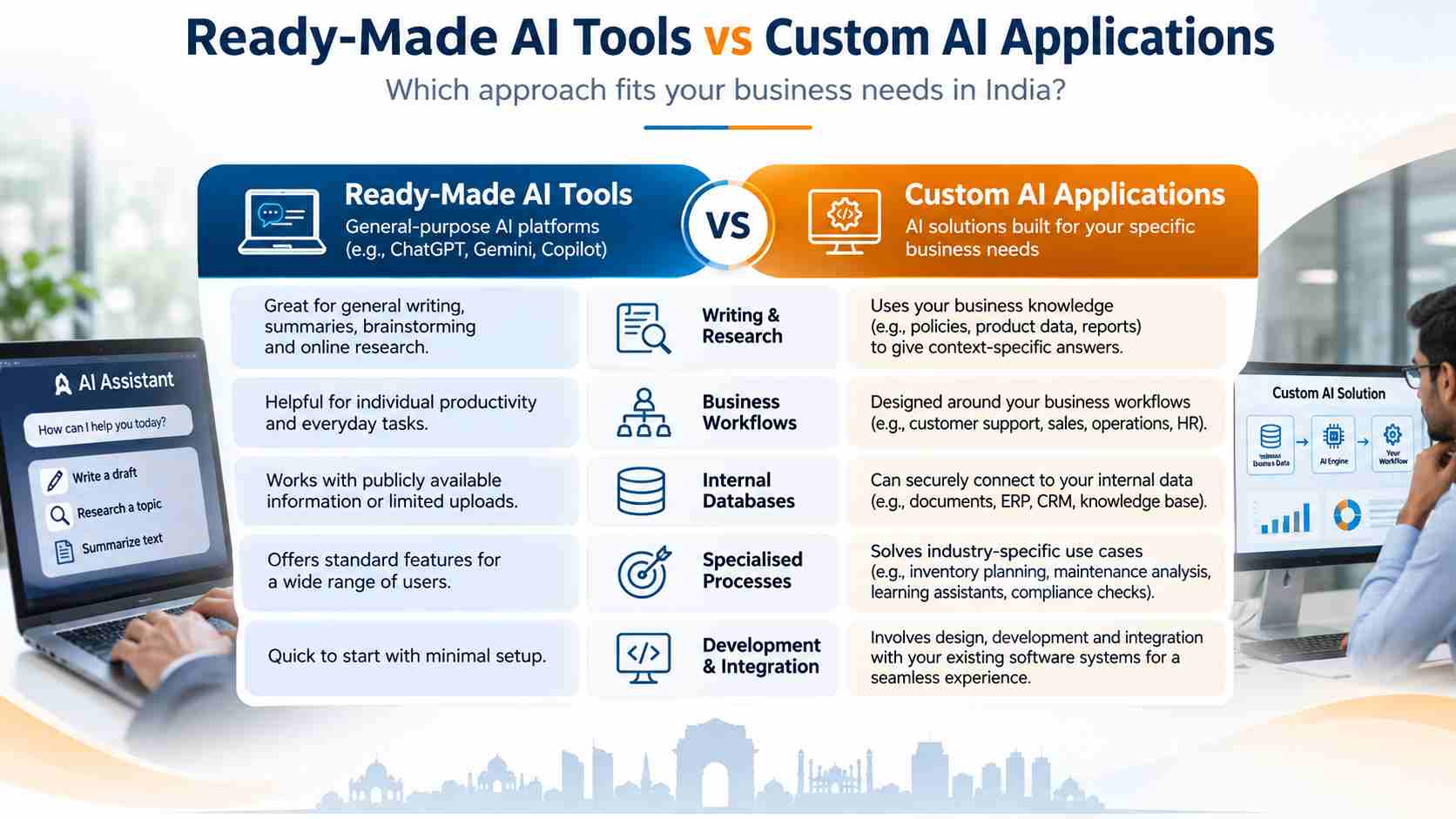
Ready-Made AI vs Custom AI: What's the Difference?
Not every business needs to build its own AI model. In fact, many custom applications use existing AI models connected to business-specific software and information.
| Ready-Made AI Tools | Custom AI Applications |
|---|---|
| Useful for general writing, research and summaries. | Designed around specific business tasks and workflows. |
| Usually quicker to start using. | May require development, testing and integration. |
| Offer standard features and integrations. | Can connect to selected internal systems and databases. |
| Often suitable for individual productivity. | Can support specialised business processes. |
The best choice depends on the problem, budget, data requirements and expected value. Sometimes a ready-made tool is enough.
What Could Custom AI Actually Do?
Consider a few practical possibilities:
- Retail: Help staff search product information and answer inventory questions.
- Manufacturing: Summarize equipment maintenance reports and identify recurring issues.
- Education: Create learning assistants based on approved course materials.
- Customer support: Retrieve relevant answers from company knowledge bases.
These examples do not necessarily require training an AI model from scratch. Developers can often combine existing models with secure data connections, search systems and carefully designed software.
Why Businesses Can't Ignore Accuracy and Privacy
AI can produce convincing but incorrect answers. Connecting it to company records also raises questions about access controls, sensitive information and data protection.
Before introducing AI into important workflows, businesses need to consider testing, monitoring, security and human review.
These responsibilities matter just as much as selecting the technology itself.
What Comes Next for India's AI Industry?
As more organisations explore practical AI applications, opportunities may grow for developers working on specialised software, multilingual experiences and intelligent business systems.
But the future is unlikely to be about every company creating its own ChatGPT. It may be about choosing the right AI technology and making it work reliably with real business processes.
The next big AI breakthrough for a business might not be a bigger model. It might simply be a better solution to a problem people face every day.
Have a business idea that could benefit from custom AI? Connect with Accolade Tech Solutions to explore generative AI application development, custom AI software, intelligent automation and integration with existing business systems.
Contact: 9900448554 | Website: accoladetechsolutions.com